
Prescott City Council Study Session: Facility’s Needs, Prop 478 Cost Updates, and Staff Growth Debate
We bought the Ferrari but are still riding horses.


The Prescott City Council’s May 26 study session delivered a data-heavy look at city facilities and a follow-up to the FY2027 budget workshops. Terracon Consultants presented a long-overdue Facility Condition Assessment of 69 buildings across 35 sites. The budget discussion covered City Court staffing, public safety tax (Prop 478) capital reconciliation, solid waste rates, and the Raftelis Operational Analysis of the Community Development Department recommendations to hire 3 new Community Development positions. To watch the entire session, Click Here.
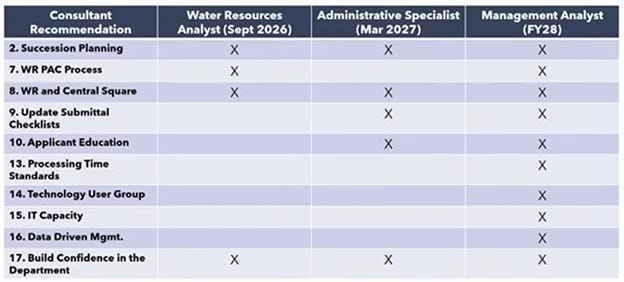
Community Development staff (Will West) presented the Raftelis recommendations and explicitly proposed the following three-phase rollout of the 17 recommendations and how each new hire would address Phased Implementation Recommended:
1. Water Resources Analyst: First / Highest Priority - September 2026 (mid-FY2027).
Why first? Staff described this as addressing the most critical and immediate needs to clearing backlogs in development agreements and water service agreements, fixing process deficiencies, improving water review integration, and supporting the City’s Long-Term Water Management Plan.
2. Administrative Specialist: Second phase – March 2027
To be brought on after the Water Resources Analyst. Purpose: Handle clerical and administrative tasks so higher-paid technical staff can focus on specialized work; also supports Land Development Code updates and other long-term planning projects.
3. Management Analyst: Third / Final phase – Recommended for Fiscal Year 28
Purpose: Provides broad department-wide support for data-driven management, research projects, process improvement, and filling multiple operational gaps identified in the Raftelis study. Staff viewed it as important but less urgent than the first two.
Software Purchase + Persistent Inefficiencies = Staffing Request
For those of us who have had similar discussions in boardrooms over the last twenty years, we see a classic case of technology acquisition without full organizational change management. The city bought Central Square (a modern permitting, licensing, and land management system) presumably to modernize Community Development processes, enable mobile inspections, better data tracking, workflow automation, and reduce backlogs.
However, the software is underutilized because:
Staff lack training/capacity to fully implement it (”IT capacity” and “technology user group” items pushed to FY28).
Technical staff are doing clerical work instead of leveraging the system’s automation features.
Processes and data management haven’t been fully re-engineered around the new tool.
This creates a “we bought the Ferrari but are still riding horses” situation. The Raftelis operational analysis diagnosed these gaps and recommended 3 additional staff to unlock the software’s value and fix broader deficiencies. Their hiring recommendations aren’t just “more bodies”, it’s capacity to realize ROI on prior tech investment.
Will City Council Act on These Recommendations
You betcha, but it seems they are in a rush to get this going now rather than the recommended phased in approach, with the Mayor Rusing leading the charge.
Mayor Pro Tem Lois Fruhwirth was once more the voice of fiscal reality. She repeatedly contrasted Prescott’s modest population growth (5.4% from 2020–2025) with city-wide staff growth (10.7% just from FY22 to FY25) and delivered one of the session’s most pointed observations during the Community Development staffing discussion:
Her charts and comments made the mismatch unmistakable: government is expanding faster than the community it serves, yet core problems (slow permitting, incomplete water tracking, frustrating applicant experiences, and overall inefficiency) remain unsolved. She demanded full Prop 478 cost reconciliations, realistic CIP numbers, and internal offsets before simply adding more positions.
Our question: “We’ve added 120 employees and we still need to fix permitting, water integration, applicant experience, and efficiency.”
The session’s most eyebrow-raising moment came from Councilmember Ted Gambogi shot back when Fruhwirth pointed out her concerns about staff growth:
“I think it’s disingenuous to compare the population growth to the staff growth. I mean, one of the reasons we have Proposition 478 is because we fell behind.”
Okay, Ted.
We had to raise taxes on every resident and visitor because the city had chronically underfunded its most basic responsibility, keeping citizens safe. So the logical response is… let’s just keep hiring more staff across the board?
Talk about disingenuousness.
Our Bottom Line Take and Recommendations
Government bureaucracy and bloat simply cannot bob and weave like a private corporation laser-focused on profit, efficiency, and results. We agree with Mayor Pro Tem Lois Fruhwirth: The City must aggressively hunt for real efficiencies and make the tough call to cut “wants” to properly fund “needs.”
A prime example is the $1.75 million earmarked for more open space acquisition, which nice to have, but delivering zero financial ROI to taxpayers when we have millions of square feet of vacant retail and commercial space, affordable housing shortages and the impact of the residential rental decline,
If the council decides to move forward with the three new Community Development positions rather than strictly following Raftelis’ recommended phasing, then approve all three now (or at minimum the first two immediately and the Management Analyst in early FY28). Our recommendations are straightforward:
Any approval must come with iron-clad accountability:
Tie the new hires to hard KPIs (permit time reduction targets, backlog clearance, Central Square utilization rates, water agreement turnaround).
Require a 6-month implementation plan for Central Square upgrades led by the new Management Analyst.
Schedule a sunset review in 18 months - If measurable efficiencies aren’t showing, adjust or eliminate positions.
Going forward, mandate that any major software purchase includes dedicated implementation staffing and training dollars in the same budget.
The session delivered useful data on facility conditions and budget stark realities, but it also revealed the same familiar pattern: informative slides, a handful of good questions, yet insufficient hard scrutiny on whether new spending (facilities, staff, or otherwise) truly delivers bang for the taxpayer buck.
As the tentative FY2027 budget heads to adoption, the council now has a chance to show it can and does prioritize the budget line items, understands the difference between wants and needs, and that every dollar must earn its keep.
Taxpayers aren’t asking for less safety or worse roads; they’re simply asking for proof that their investment is appropriately assessed and on reflection is actually working.